Restaurant Phone Charging Stations: NYC's Borough Gap
NYC has 14.2 free LinkNYC charging ports per 100 restaurants, and Manhattan has twice Brooklyn's share. Why bars and restaurants add their own stations.
 By
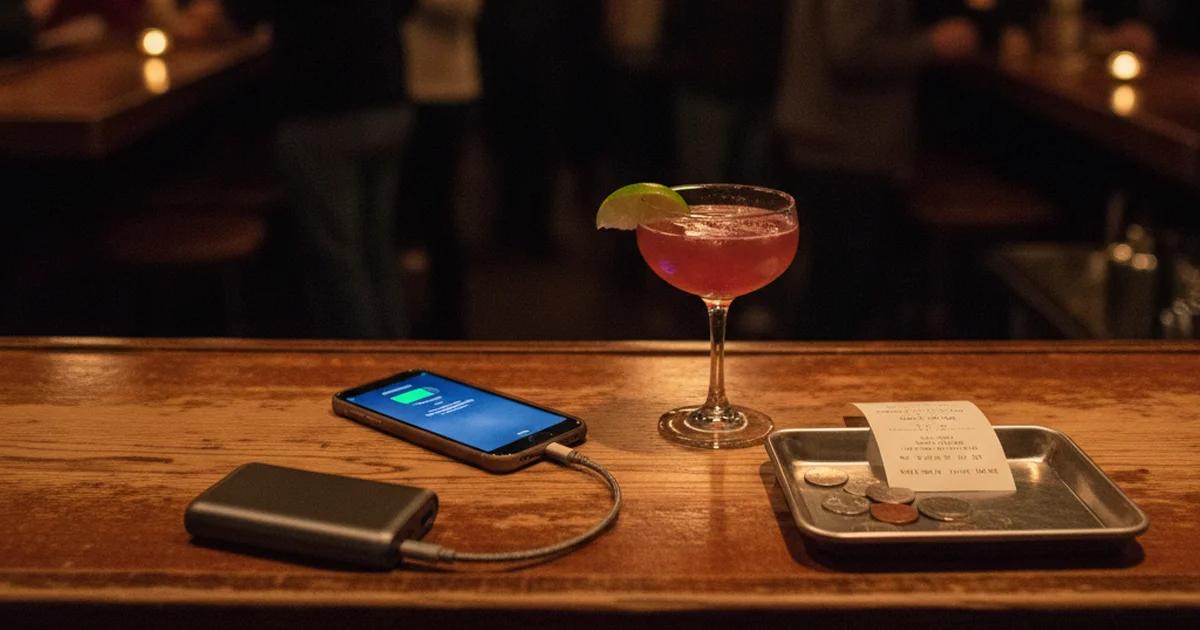
Sit down at almost any New York restaurant this year and count how many times the phone comes out before the check is closed. It pulls up the menu from a QR code on the table. It holds the Resy or OpenTable confirmation that got you the table. It pays the tab with a tap, splits it with friends, and at the end of the night it calls the car home. A phone at 4% is no longer a personal problem for the diner. It is a problem for the room.
That is why the humble phone charger has quietly become a piece of hospitality equipment. Some bars keep a drawer of cables behind the counter. Some cafes seat laptop users next to the outlets. A growing number of venues now host a self-service rental station, where a guest takes a charged power bank to the table and drops it off later. And outside on the sidewalk, the city itself runs a public network of free charging ports on its LinkNYC kiosks.
Manhattan Monday wanted to know how much of that public charging actually sits near where New Yorkers eat and drink, borough by borough. The answer is uneven, and it explains why the decision to add a phone charging station for restaurants is increasingly made inside the venue rather than left to the street.
The phone is the menu, the wallet and the ride home
Start with who is carrying the device. Pew Research Center's 2026 mobile fact sheet, based on a survey conducted January 30 to June 18, 2026, found that 91% of US adults own a smartphone. Among adults under 50, the figure is 97%.
Then look at what diners say they will do with it. In the National Restaurant Association's Restaurant Technology Landscape Report 2024, 62% of full-service customers said they would pay the check using contactless or mobile payment options, and 57% would use a digital wallet such as Apple Pay or Google Wallet. Among millennials, those numbers rose to 82% and 80%. Fifty-nine percent said they would pull up a menu on their smartphone using a QR code.
Diners do not all love it. A Toast survey of 850 adults found that 81% still prefer a physical menu and only 1% prefer QR codes over other formats; 26% named small print as their least favorite thing about QR menus. But preference is not the same as practice. Even a diner who would rather hold a paper menu still pays, books, splits and rides with the phone. When the battery dies mid-meal, the restaurant inherits the consequences: a guest who cannot pay the way they planned, a table that lingers waiting for a friend to settle up, or a customer who walks out into the night with no way to call a car.
The industry absorbing that risk is large. In a July 2026 op-ed with the New York City Hospitality Alliance, State Comptroller Thomas DiNapoli wrote that the city's restaurants and bars employed nearly 280,000 people in 2024, supported more than $11.4 billion in wages and contributed more than $2.8 billion to city coffers in fiscal year 2025. The same piece warned that the "more than 23,000 neighborhood establishments" remain economically fragile, with restaurant jobs down at times by roughly 9,600 year over year as of April 2026. For operators watching every check, small amenities that keep guests seated and able to pay are not trivial.
The free option on the sidewalk: LinkNYC
New York already has a public phone charging network, and it is bigger than many people realize. The city's Office of Technology and Innovation describes LinkNYC as the program that replaced pay phones with kiosks offering free Wi-Fi, free calls, access to 911 and 311, and "USB ports for free mobile device charging." According to the LinkNYC FAQ, every Link has two USB outlets below the headphone jack, connected to power only so they cannot exchange data with a device. The newer, taller Link5G kiosks keep the same feature: "Charge your device in a power-only USB port."
The city publishes every kiosk location on its open data portal. The LinkNYC Kiosk Locations dataset, last updated April 2, 2026, lists 2,240 kiosks with the status "Live" once the four remaining public payphones in the file are set aside. Another 11 are marked "Removed Pending Reinstall."
The kiosks mostly work. When the City Comptroller audited 979 Manhattan kiosks in 2020, it found that 914, or 93%, had operable USB charging ports that could charge a phone. That audit is six years old, and no newer public test of the ports turned up in our research.
There are limits, though, for anyone sitting at a table. A LinkNYC port is outdoors, on the curb, and it requires the user to carry their own cable. It charges the phone where the kiosk is, not where the guest is eating.
Where the ports are, and where the restaurants are
To see how public charging lines up with dining, we compared two city datasets. The first is the LinkNYC kiosk file above. The second is the Health Department's restaurant inspection results, which covers restaurants and college cafeterias in active status, including new ones still awaiting their first inspection. We counted each establishment once, using its unique record number.
That file contained 31,461 establishments with a borough on November 20, 2026. It is a broader count than the Comptroller's 23,000, because the permit list includes coffee shops, bakeries, juice bars and other food-service businesses alongside sit-down restaurants and bars that serve food. We then doubled the kiosk count, since each Link carries two USB ports, and divided by the number of establishments in each borough.
| Borough | Food-service establishments | Live LinkNYC kiosks | Free USB ports | Ports per 100 establishments | Establishments per kiosk |
|---|---|---|---|---|---|
| Manhattan | 12,618 | 1,221 | 2,442 | 19.4 | 10.3 |
| Bronx | 2,647 | 215 | 430 | 16.2 | 12.3 |
| Queens | 7,022 | 397 | 794 | 11.3 | 17.7 |
| Brooklyn | 8,048 | 357 | 714 | 8.9 | 22.5 |
| Staten Island | 1,126 | 50 | 100 | 8.9 | 22.5 |
| Citywide | 31,461 | 2,240 | 4,480 | 14.2 | 14.0 |
Source: Manhattan Monday analysis of NYC Open Data, LinkNYC Kiosk Locations (updated April 2, 2026) and DOHMH Restaurant Inspection Results (updated November 19, 2026), both queried November 20, 2026. Kiosks with status "Live", payphones excluded; 102 establishments with no borough excluded; two USB ports per kiosk per LinkNYC.

Chart: Manhattan Monday analysis of NYC Open Data (LinkNYC kiosk locations and DOHMH restaurant inspection results), checked November 2026. Ports per 100 establishments = live kiosks x 2 USB ports / establishments x 100.
New York City has 14.2 free LinkNYC charging ports for every 100 food-service establishments, and Manhattan's 19.4 is more than double the 8.9 in Brooklyn and Staten Island.
Three things stand out. First, Manhattan holds 54.5% of the city's live kiosks but 40.1% of its food-service establishments. Second, the Bronx does better than its size suggests, with 16.2 ports per 100 establishments, second only to Manhattan. Third, Brooklyn, the borough with the second-largest restaurant scene, has one kiosk for every 22.5 establishments, the same ratio as Staten Island.
The city is trying to shift that balance. OTI says the 2021 franchise amendment requires CityBridge, LinkNYC's operator, to put 90% of new kiosks in the outer boroughs and above 96th Street in Manhattan, with minimum builds promised in neighborhoods such as Bushwick, Brownsville and Ocean Hill in Brooklyn and Jamaica and Hollis in Queens. Until that build-out catches up, a Brooklyn diner with a dying phone is, on average, less likely to find a public port on the block.
Even in Manhattan, the ratio is a ceiling, not a promise. A port on the corner of Third Avenue does nothing for a guest halfway through a tasting menu, and 19.4 per 100 is still fewer than one port for every five establishments.
What NYC restaurants and bars actually offer inside
Inside the venue, the options fall into three rough groups.
The outlet and the borrowed cable. The oldest answer is a bartender who will plug in a phone behind the bar. It costs nothing, but it ties up staff, puts a guest's device out of their reach, and creates the awkward moment at closing when someone's phone is still on the back counter.
Seats next to outlets. Some coffee shops build power into counters and communal tables. That suits a laptop session. It suits a dinner table less well, since few dining rooms have outlets at every two-top.
Self-service rental stations. The fastest-growing option is a station that dispenses portable power banks with built-in cables. The guest unlocks one with an app, takes it to the table, and returns it to the same station or another one in the network. Recharge.City, one New York operator, said in a May 2023 press release that it had installed more than 1,000 stations in the city and that rentals were free for an hour or $5 a day. Its own website now lists "600+" stations, so the network's current size is lower than that 2023 claim, and its partner page tells venues the installation is "totally free."
ChargerGoGo, which says it works with venues nationwide, offers the same kind of station. Its page on phone charging stations for restaurants and bars pitches them as a way for guests to "snap photos, pay their tabs, and request rides home without worrying about battery life," and lets operators choose between consignment, subscription and enterprise models. The company describes a venue operator as one who may earn revenue from the service or offer it as a free amenity. Its venue operators page adds that the battery stays with the user, so the venue carries no liability for the guest's phone, and that a power bank charges a phone from 1% to 100% in 45 to 60 minutes.
How an operator might decide
The case for a bar phone charging station, or one in a dining room, is strongest where the phone does the most work during the visit:
- Venues built around QR ordering or pay at table. If the menu and the check both live on the guest's phone, a dead battery stops the transaction, not just the photo.
- Late-night bars. The last thing a guest does before leaving is order a car. A station by the door is a safety feature as much as a convenience.
- Blocks with little public charging. By the numbers above, a Brooklyn or Staten Island venue is less likely to have a LinkNYC port nearby than one in Manhattan or the Bronx.
- Rooms with long dwell times. Brunch spots, sports bars and group dinners keep guests seated for hours, long enough for a rental battery to make a difference.
The questions to ask any vendor are simple: who pays for the hardware, who handles lost batteries, whether the venue earns a share of rentals, how much counter or wall space the station needs, and what it costs the guest.
New York has spent a decade putting free charging on its sidewalks, and 2,240 live kiosks is a real public asset. But a port on the corner is not a charger at the table. As the phone has taken over the menu, the wallet and the ride home, the restaurants that keep it alive are the ones that decided the job was theirs.
Sources
- NYC Open Data: LinkNYC Kiosk Locations (Office of Technology and Innovation)
- NYC Open Data: DOHMH New York City Restaurant Inspection Results
- LinkNYC: Frequently asked questions
- NYC Office of Technology and Innovation: LinkNYC
- LinkNYC: Link5G
- NYC Comptroller: Final Letter Report on LinkNYC Kiosks, Phase III Manhattan (2020)
- Office of the New York State Comptroller: Op-Ed, This Industry Employs Every Neighborhood (July 2026)
- National Restaurant Association: Restaurant Technology Landscape Report 2024
- Toast: How Guests Really Feel About QR Code Menus
- Pew Research Center: Americans' Use of Mobile Devices in 2026
- Recharge.City press release via Digital Journal (May 2023)
- Recharge.City