Aqua Cosmos Hudson Canyon Public Art on Brooklyn Bridge
Aqua Cosmos Hudson Canyon public art on the Brooklyn Bridge highlights a data-driven look at the Brooklyn Bridge projection event and its conservation…
 By
By 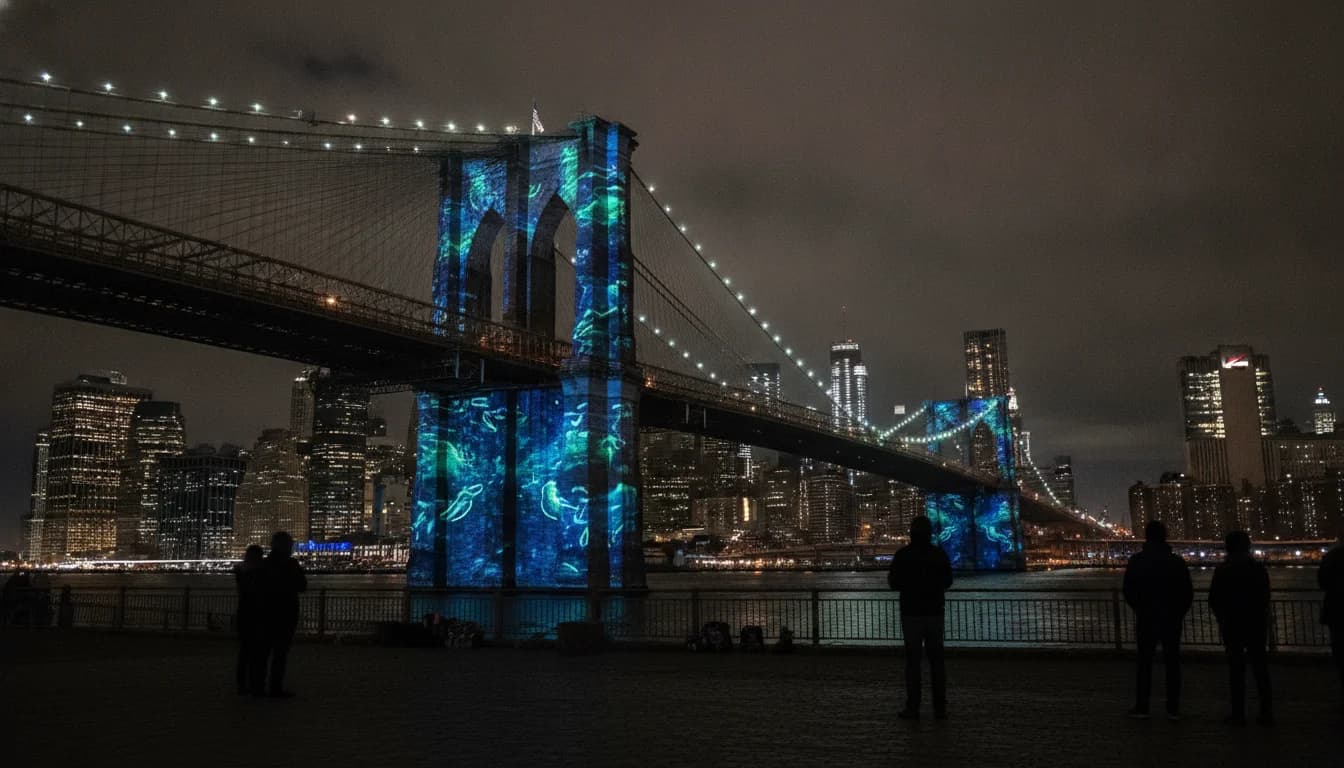
Aqua Cosmos Hudson Canyon public art on Brooklyn Bridge.
AQUA COSMOS: The Hudson Canyon is an 18-minute immersive projection that will unfold on September 25–26, 2026, from 7 p.m. to 10 p.m. each night on the Brooklyn Bridge, according to a Wildlife Conservation Society news release dated August 7, 2026. The project is being presented in partnership with the Wildlife Conservation Society (WCS), ArtW, and NYC DOT Art, and will be visible from the Emily Warren Roebling Plaza at Brooklyn Bridge Park. This major public art installment marks a milestone in the fusion of art, science, and conservation messaging, and it showcases how immersive media can illuminate remote marine ecosystems for urban audiences. This opening timeframe is part of a broader effort to raise awareness about the Hudson Canyon, a submarine canyon located roughly 100 miles off the New York Coast, and to inspire public engagement in marine conservation. The project leverages NOAA footage captured in September 2025, paired with archival imagery from the WCS history, to bridge a century of ocean discovery with contemporary visual storytelling. The immediate impact is a high-visibility, city-facing event designed to attract both art enthusiasts and conservation supporters into a shared, data-informed conversation about protecting offshore ecosystems. (newsroom.wcs.org)
What Happened
Announcement Details
- AQUA COSMOS: The Hudson Canyon will be an 18-minute immersive public art installation projected onto the Brooklyn Bridge, created by multimedia artist Anita Glesta in collaboration with the Wildlife Conservation Society (WCS) and ArtW, and presented through NYC DOT Art. The two-night engagement is scheduled for Friday, September 25, and Saturday, September 26, 2026, with viewing hours from 7 p.m. to 10 p.m. each night. Viewers are invited to gather at Emily Warren Roebling Plaza, Brooklyn Bridge Park, to experience the projection. This foundational information comes directly from WCS’s August 7, 2026 press release and accompanying materials. (newsroom.wcs.org)
- The project’s core concept centers on turning the Brooklyn Bridge into a portal to the Hudson Canyon, one of the Atlantic’s largest submarine canyons, to highlight biodiversity and the need for protection. The press materials note the canyon’s significance, including its depth and species richness, and describe the immersive video as blending archival art, journals, animation, painting, and sound to connect more than a century of ocean discovery with contemporary conservation aims. NOAA footage from September 2025 is integrated to enrich the narrative with recent field data. This framing comes from the same WCS release. (newsroom.wcs.org)
- The two-night format emphasizes accessibility and public participation, with open access to the projection for all nature and art enthusiasts. The event is positioned as a citywide cultural moment that aligns with NYC DOT Art’s mission to bring temporary public artworks to NYC’s streets and civic spaces. The press materials outline the involvement of NYC DOT Art and its history of supporting hundreds of temporary artworks citywide since 2008. (newsroom.wcs.org)
Event Timeline and Key Facts
- When: Friday, September 25, 2026, and Saturday, September 26, 2026; viewing hours 7 p.m. to 10 p.m. both nights. Location: Emily Warren Roebling Plaza, Brooklyn Bridge Park, with projections onto the Brooklyn Bridge itself. These specifics are drawn from the WCS press release. (newsroom.wcs.org)
- What: The audiovisual installation, titled AQUA COSMOS: The Hudson Canyon, is described as an 18-minute immersive video show that blends historical scientific imagery with contemporary underwater footage. The installation will be projected onto a city icon, engaging a broad audience while anchoring conservation messaging in a high-profile location. The release formalizes the scope and the collaboration among WCS, ArtW, and NYC DOT Art. (newsroom.wcs.org)
- Who: The event is open to the public and positioned to appeal to “Nature & Art Lovers,” reflecting the collaboration between a nonprofit conservation organization, a contemporary arts group, and city cultural programming. Anita Glesta serves as the project’s lead artist, with WCS and ArtW contributing scientific and curatorial support, respectively. The release provides background on the artist and partner organizations. (newsroom.wcs.org)
Why This Matters
Impact and Reach
- Public art projects that anchor themselves in science and conservation can broaden audience understanding of offshore ecosystems. AQUA COSMOS: The Hudson Canyon is designed to leverage a landmark structure—the Brooklyn Bridge—to bring attention to the Hudson Canyon, a system with ecological importance and potential sanctuary designation. The project’s framing references WCS’s advocacy around the canyon’s designation and the NOAA-backed data that informs the piece. The August 7, 2026 WCS release situates the work within a longer trajectory of public engagement and policy consideration. (newsroom.wcs.org)
- The event’s public-facing venue and schedule are intended to maximize visibility and accessibility, aligning with NYC DOT Art’s track record of more than 550 artworks produced citywide since 2008. The projection’s location on a globally recognizable landmark helps translate marine science into a shared urban experience, potentially catalyzing citizen interest in conservation issues related to the Hudson Canyon. This context about NYC DOT Art’s scope and history comes from the WCS release’s description of the program. (newsroom.wcs.org)
Historical and Scientific Context
- The project explicitly honors a historical scientific lineage. The release notes the 1925 Arcturus Expedition, led by William Beebe, and acknowledges the expedition’s legacy as a milestone in early deep-sea exploration, coupled with the contributions of women scientists and artists. By pairing that historic material with modern NOAA footage from 2025, AQUA COSMOS: The Hudson Canyon weaves a narrative that links past and present ocean inquiry. This cross-temporal storytelling is highlighted in the press materials. (newsroom.wcs.org)
- The inclusion of NOAA footage and archival art underscores a broader trend in public art that foregrounds data-driven storytelling. The WCS release emphasizes the fusion of archival imagery and current field imagery to portray a living marine system, inviting audiences to consider how data and art together can illuminate ecological realities beyond the cityscape. The same source provides these details. (newsroom.wcs.org)
Artist and Organization Perspectives
- Anita Glesta’s statement, included in the press release, situates the project within her broader practice that blends memory, landscape, and science to create immersive experiences. The quote signals the artistic motivation behind AQUA COSMOS and frames the piece as part of a long-running exploration of how humans relate to underwater environments. The WCS release includes her direct words. (newsroom.wcs.org)
- WCS describes its role not merely as a sponsor but as a catalyst for a public dialog around marine conservation, leveraging a well-known city landmark to encourage viewers to reflect on the Hudson Canyon’s ecological importance. The press release clarifies the organizational collaboration and the intent behind the immersive projection. (newsroom.wcs.org)
Broader Context: Public Art, Science, and Policy
- The AQUA COSMOS project is situated within a broader ecosystem of public art initiatives that connect cultural programming with environmental science. The press materials reference NYC DOT Art’s ongoing role in presenting temporary works on or near DOT property across the five boroughs, illustrating how municipal agencies integrate artistic programming with urban infrastructure. This contextual detail is drawn from the same WCS release. (newsroom.wcs.org)
- Public art as a platform for environmental education has precedent in large-scale projections and projections onto architectural landmarks. The Brooklyn Bridge projection approach used for AQUA COSMOS builds on a lineage of art-mapped experiences that reframe familiar urban spaces as venues for ecological storytelling. While historical precedents exist, the specific AQUA COSMOS collaboration is anchored in 2026 planning and is documented in the WCS release. (newsroom.wcs.org)
What’s Next
Next Steps for Audiences
- If you plan to attend, mark your calendar for Friday, September 25, and Saturday, September 26, 2026, with showtimes from 7 p.m. to 10 p.m. each night. Attendance is open to the public, and viewing will occur at Emily Warren Roebling Plaza with projection onto the Brooklyn Bridge. The WCS release specifies these details and confirms the public-access nature of the event. (newsroom.wcs.org)
- Organizers encourage audiences to engage with the conservation narrative surrounding the Hudson Canyon, leveraging the projection as a catalyst for dialogue about offshore ecosystems and policy considerations. The release frames the event as part of a broader effort to raise awareness and support for protective measures, aligning with WCS’s ongoing advocacy work. (newsroom.wcs.org)
Longer-Term Implications and Monitoring
- In terms of impact, observers will be watching how a high-profile urban projection can influence public perceptions of marine conservation and how such events translate into real-world engagement, such as donations, volunteering, or participation in citizen-science programs. While the WCS release foregrounds the artistic and conservation goals, the longer-term effects will depend on subsequent outreach, partnerships, and the public’s reception to the immersive format. This framing draws on the event’s stated goals in the press release. (newsroom.wcs.org)
What Happens After the Event
- The WCS release does not detail post-event activities, but it implies a continuing collaboration among WCS, ArtW, and NYC DOT Art, suggesting potential follow-up discussions, educational programming, or online materials that extend the viewing experience beyond the live projection. Given the involvement of NOAA footage and archival material, there may be opportunity for ongoing digital engagement or accompanying exhibitions in the months after the public dates. The press release outlines the core event and participates in a broader network of public-facing conservation education. (newsroom.wcs.org)
Closing
In a city famed for its towering skyline and constant stream of cultural events, AQUA COSMOS: The Hudson Canyon adds a scientific dimension to the public art calendar by using immersive projection to reveal a distant marine world. The collaboration among Anita Glesta, WCS, ArtW, and NYC DOT Art demonstrates how art and science can converge to illuminate ecological issues for urban audiences in a tangible, memorable format. The projection’s timing, its location on the Brooklyn Bridge, and its alignment with NOAA data create a moment where data-driven storytelling and public engagement meet on one of New York’s most iconic civic stages. As audiences gather in Emily Warren Roebling Plaza to experience the 18-minute visualization, they step into a dialogue that extends beyond the viewing moment—into conversations about marine protection, climate resilience, and the ways in which cities can foreground science through art.
For readers seeking ongoing updates, the Wildlife Conservation Society’s Newsroom and the NYC DOT Art program will be the primary channels for official information. In the meantime, the Hudson Canyon’s public art projection on the Brooklyn Bridge offers a striking example of how contemporary media can translate scientific inquiry into public awareness, inviting New Yorkers to consider the oceans that lie just beyond the city’s horizon and the options available to protect them. The collaboration highlights a growing trend where cultural institutions, scientific organizations, and municipal agencies co-create experiences that inform, inspire, and mobilize audiences around environmental stewardship. As this initiative unfolds, it will be essential to track community feedback, attendance patterns, and any subsequent educational programs that accompany the live event, to gauge the effectiveness of immersive art in advancing conservation outcomes. (newsroom.wcs.org)