Open-Weight Document AI Lets Companies Keep Files In-House
SoMarkAI's open-weight OXR model lets companies parse contracts, filings and records on their own servers. What running it in-house takes, and what the license allows.
 By
Hospitals, law firms, banks and government contractors are under pressure to use AI on their documents. Many of those documents are exactly the kind that cannot leave the building: patient records, contracts under privilege, loan files, regulated filings. For these organizations, the question is often where the AI runs before it is how good the AI is.
A model released this month adds an option. On October 20, 2026, SoMarkAI, a document-parsing company headquartered in Shanghai, released the code and weights for OXR (Optical Everything Recognition), a 1.3-billion-parameter model that converts PDFs and scanned pages into structured Markdown or JSON. Because the weights are downloadable, an organization can run the model on its own servers, and the documents it processes never travel to an outside service.

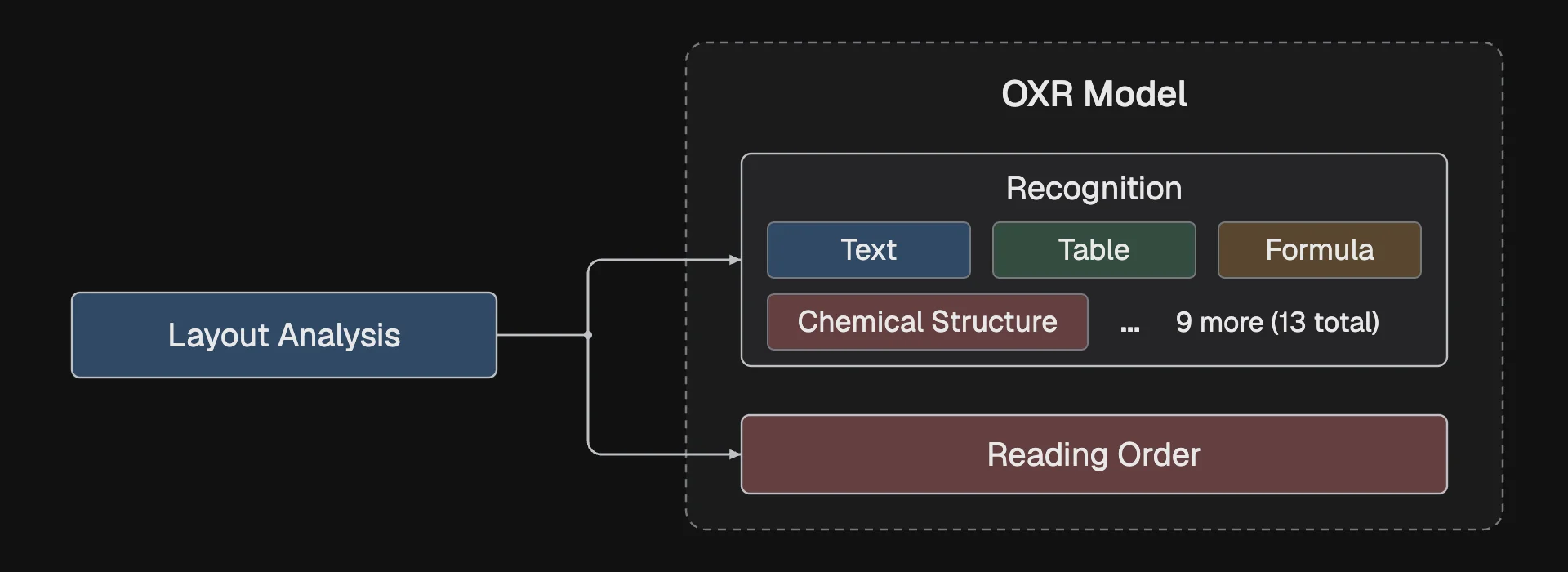
The OXR pipeline: layout analysis, then recognition and reading order in one model. Source: SoMarkAI.
Why parsing is the sensitive step
AI assistants that answer questions about a company's documents typically rely on a technique called retrieval-augmented generation, or RAG. Before the system can retrieve anything, every document has to be converted from a PDF or image into text the system can index. That conversion, document parsing, touches every page in full.
When parsing runs through an outside service, every page is sent to that service. For regulated data this brings obligations. In the United States, health care providers that share protected health information with a vendor generally need a business associate agreement under HIPAA rules. In Europe, sending personal data to a processor triggers the contract requirements of Article 28 of the GDPR. Many firms also carry client confidentiality duties of their own.
Running the parser on in-house hardware removes the outside processor from that step. The files stay on infrastructure the organization already governs.
What the model does
OXR reads a page and produces structured output, with layout coordinates attached to every element so each extracted table or paragraph can be traced back to its place on the page. It recognizes 13 element types. Tables come out as HTML or Markdown, formulas as LaTeX, chemical equations in mhchem notation and chemical structures as SMILES. Page headers and footers are filtered out by default.
SoMarkAI says the model handles difficult layouts, including newspapers, A3 exam papers, vertical text and handwriting, and its repository on GitHub includes examples for resumes, research reports, academic papers and chemistry documents.
In SoMarkAI's comparison against published scores, OXR ranks first on three public benchmarks: olmOCR-Bench (87.84), OmniDocBench (97.18) and DocParsingBench (87.76). The company notes that competitors' scores come from published papers and leaderboards, and its evaluation setup is public.
SoMarkAI credits the results to two parts working together. The model's architecture keeps layout analysis as a separate, replaceable model while recognition and reading order run in one pass. Its training uses a recursive self-improvement loop that finds the samples the model misreads or is uncertain about and generates targeted training data for them, with no human annotation.
What running it in-house takes
The hardware bar is within reach of most IT departments. SoMarkAI lists a Linux server with an NVIDIA GPU that supports BF16. A single GPU with 24 GB of memory is enough for low-concurrency testing, and 48 GB or more is recommended for long documents or heavier use. An all-in-one Docker image starts the full stack, including a parsing API, a layout service and a local demo page.
Speed matters for in-house deployment because the organization pays for its own hardware. In SoMarkAI's test of 21 models, each on one NVIDIA RTX PRO 6000 GPU, OXR processed 100 pages in 100.972 seconds, the fastest result. That works out to about 85,000 pages a day on a single GPU.
The model is also small. At 1.3 billion parameters, it is a fraction of the size of the general-purpose AI models many companies already run, which keeps hardware costs and energy use down.
Retention is easy to reason about. The weights are downloaded once, from Hugging Face or ModelScope, and the services then run on the organization's own machine. The local demo page keeps uploaded files in a temporary cache that expires after one hour by default, and the parsing API returns results to the caller. Security teams reviewing the deployment can trace where every page goes, because every step runs on hardware they control, and the code for each service is published in the repository for inspection.
Customizing for specialized documents
Regulated industries often have document formats no general model has seen: insurance claim forms, lab reports, court filings with fixed structures. OXR's layout step is designed for that situation. Layout analysis runs as a separate model, so an organization can swap in a layout model trained on its own forms while keeping OXR for recognizing text and putting it in the right order. To SoMarkAI's knowledge, OXR is the first document parser to make layout analysis independent and pluggable this way.
The license
OXR is released under a custom license based on Apache 2.0, which organizations should review before deployment. Commercial use is free for organizations below USD 2 million in total funding or annual revenue. Above either threshold, a commercial license from SoMarkAI is required. The license also bars offering a hosted API that competes with SoMarkAI's own, a restriction that applies regardless of company size. Internal use behind a company's firewall falls outside that clause. Legal teams should still read the full license text in the repository, since the funding and revenue thresholds are defined there and decide which terms apply to a given organization.
Trying it first
Organizations can evaluate the model before installing anything. SoMarkAI runs a free hosted demo and API at free-oxr.somark.ai with no signup, intended for testing with non-sensitive documents. Requests are queued and the service is not meant for production. Once a team is satisfied with the output on sample files, it can download the weights from Hugging Face or ModelScope and run the same workflow on its own hardware, where the sensitive documents can go.
For organizations that have held back from document AI because of where their files would end up, open-weight models such as OXR change the starting conditions: the model comes to the data, and the data stays home.