After the Boom: Billionaires' Row Faces Its Reckoning
The pencil towers of 57th Street promised a new class of trophy home. A decade on, the market is deciding what they are actually worth.
 By
By 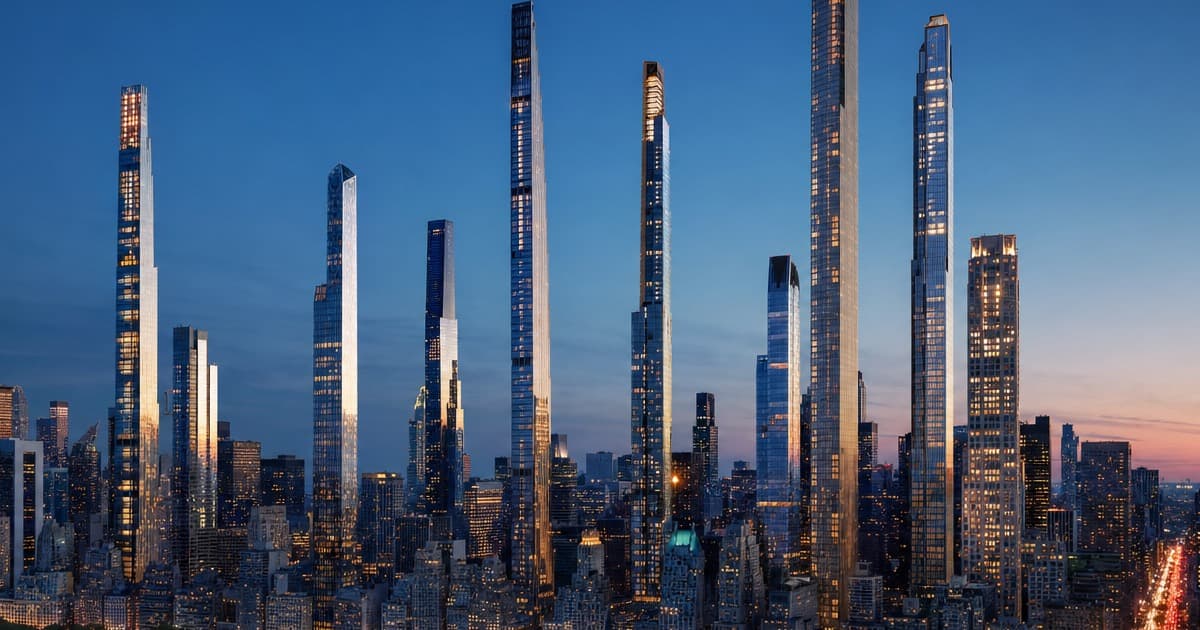
Walk south along the edge of Central Park and look up, and you see the last decade of Manhattan ambition rendered in steel and glass. The supertall towers of 57th Street, the strip the press christened Billionaires' Row, were built on a simple bet: that the world's wealthiest people would pay almost anything for a very high floor and a very good view.
For a while, the bet paid off spectacularly. Then it got complicated.
The towers that redefined thin
The row is really a cluster of record-setters. One57 opened the era. 432 Park Avenue pushed residential height to new extremes and has since become better known for cracks and lawsuits than for its views. 111 West 57th Street, the Steinway Tower, stretched engineering to a height-to-width ratio of roughly 24 to 1, making it one of the thinnest skyscrapers ever built. Central Park Tower rose higher still, claiming the title of the world's tallest residential building by roof height.
Each was a feat. Building this tall and this narrow requires enormous tuned mass dampers to control sway, exotic high-strength concrete, and structural gymnastics that would have been impossible a generation ago. The towers proved that engineering was no longer the constraint. The market was.
The one that worked, and the ones that struggled
Not every address performed the same. 220 Central Park South became the era's runaway success, home to the most expensive residential sale in American history and a magnet for finance royalty. Others told a more sobering story: units that sat unsold for years, asking prices quietly cut, and sponsors carrying the cost of empty apartments long after the ribbon-cuttings.
The problem was partly supply. A narrow slice of buyers can absorb only so many nine-figure apartments, and the row delivered a lot of them at once. It was partly also the nature of the buyers. Many units were bought as investments or occasional second homes held through anonymous shell companies, which left some of these towers sparsely lived in, their lobbies quiet and their tax profiles a subject of political fights.
The reckoning
The supertall boom did not fail, exactly. It stands, literally, as one of the most striking transformations of the New York skyline in a century. But the shine has worn off the idea that height and price move together forever. Structural headaches at 432 Park, slow resales elsewhere, and the sheer carrying cost of ultra-luxury inventory have all forced a more honest conversation about what these homes are worth.
The next generation of New York towers will be judged less on how high they can go and more on whether anyone actually wants to live there. On Billionaires' Row, that question is finally getting an answer.